Why Can't I Smell My Reed Diffuser?

Why Can't I Smell My Reed Diffuser?
There is a particular disappointment that comes with walking into a room, taking a deep breath, and detecting… nothing. You stare at the vessel sitting on the console table—the sleek glass, the bundle of porous reeds, and the premium oil you carefully selected for its complex notes of sandalwood and bergamot. By all accounts, it should be working, yet the air remains stubbornly neutral.
If you have found yourself asking, “Why can't I smell my reed diffuser?” you are not alone. This is one of the most common frustrations in home fragrance. Fortunately, the answer is rarely a defective product; more often, the issue lies in a combination of physics, biology, chemistry, and simple maintenance.
To restore the "scent throw" in your space, let's dive into the science of diffusion and how you can troubleshoot your way back to an aromatic home.

1. Understanding the Science: How Reed Diffusers Work
Unlike a scented candle, which uses heat to volatilize fragrance molecules, or an ultrasonic diffuser, which uses vibrations to create a mist, a reed diffuser relies on passive capillary action.
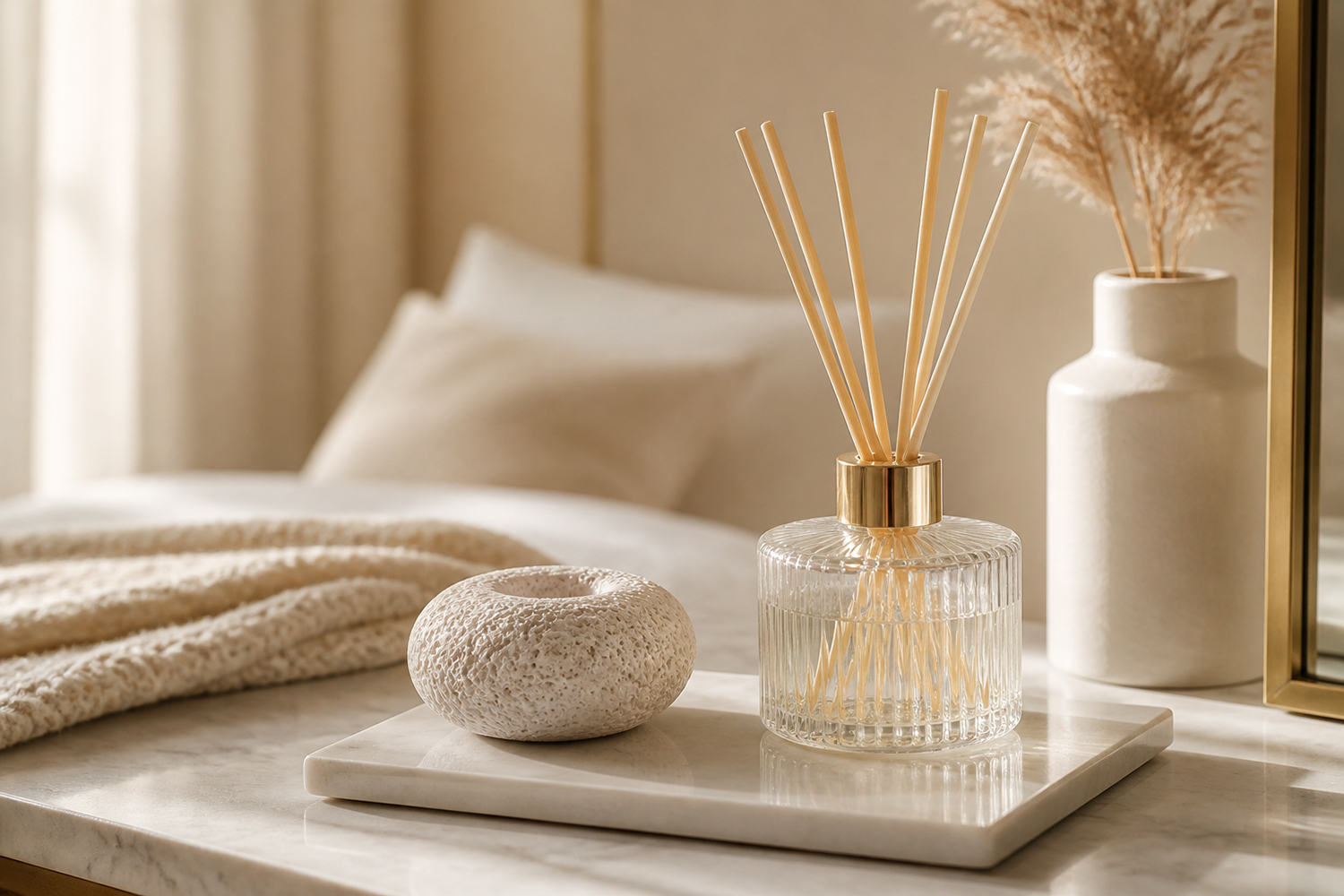
The reeds—typically high-quality rattan or specialized fiber—are filled with tiny, straw-like channels. When placed in the fragrance oil, these channels draw the liquid upward. Once the oil reaches the exposed top of the reed, it evaporates into the air. It is a slow, elegant, and entirely passive system. However, because it is passive, it is easily influenced by its environment.

2. The Biological Factor: Olfactory Fatigue
The most common culprit for a "scentless" room isn't a mechanical failure, but a biological phenomenon known as olfactory fatigue (or nose blindness).
Your olfactory system is designed to detect changes in the environment—specifically potential threats. When a scent is constant and non-threatening, your brain gradually filters it out to conserve neural resources. You might walk into your home after a long day and be greeted by a beautiful wave of fragrance, only to find it "disappears" within twenty minutes. This doesn't mean the diffuser stopped working; your brain has simply moved the scent to the background.
Pro Tip: To test this, leave the room for at least 30 minutes. If you smell the fragrance upon entry, your diffuser is functioning perfectly. To combat nose blindness, try scent rotation—switching between different fragrance profiles every few weeks to "reset" your sensitivity.

3. Strategic Placement and Airflow
Placement is paramount for a successful scent throw. Because reed diffusers rely on evaporation, they require air movement to carry the molecules across the room.
- Avoid Stagnant Corners: If your diffuser is tucked behind books or in a dead-air corner, the fragrance molecules will simply linger in a microscopic cloud directly above the bottle.
- Find the "Traffic" Areas: The ideal location is a high-traffic spot with gentle air circulation—near a doorway, a hallway, or a landing. The movement of people walking past creates enough air turbulence to help disperse the scent.
- Watch the Extremes: Avoid placing diffusers directly in front of air conditioners, heaters, or open windows. While airflow is good, excessive drafts will cause the oil to evaporate too rapidly without allowing the scent to "settle" in the space.

4. Reed Maintenance: The Art of the Flip
The reeds themselves are often the source of the problem. Over time, the tiny capillaries in rattan can become clogged with dust or saturated with heavier oil molecules, effectively "sealing" the reed.
To keep the fragrance fresh, you must flip your reeds regularly.
- Frequency: Flipping once a week is standard. If you want a more intense fragrance for a special occasion, flip them 24 hours in advance.
- Avoid Over-Flipping: Flipping every day can lead to rapid oil consumption and may actually trigger olfactory fatigue faster.
- The Replacement Rule: Reeds are not immortal. After 2 to 3 months, or once you start a new bottle of oil, replace the reeds entirely. Old, dust-clogged reeds lose their wicking integrity and won't deliver a clean scent.

5. Rattan vs. Fiber Reeds: Which is Better?
If you’re struggling with a weak scent, consider the material of your reeds.
- Rattan Reeds: Natural and classic, these contain clear channels that wick oil. They are best for thinner oils but can occasionally clog with heavier, resinous scents.
- Fiber Reeds: These are engineered for high-performance diffusion. They are often more porous and draw up oil faster, offering a much stronger and more consistent scent throw. If you want a "room-filling" aroma, fiber reeds are often the superior choice.

6. Oil Quality and Carrier Composition
Not all fragrance oils are created equal. The perfume load (the concentration of actual fragrance vs. carrier oil) and the type of base used are critical.
- The Base Matters: High-quality diffusers use specialized, low-VOC (Volatile Organic Compound) bases that strike a balance between viscosity and evaporation rate. Cheap diffusers often use alcohol (which evaporates too fast) or mineral oil (which is too heavy to wick effectively).
- Concentration: A premium reed diffuser usually contains 15% to 25% fragrance oil. If your product is under-concentrated, no amount of maintenance will make it smell stronger.
7. Environmental Impact: Humidity and Temperature
The physics of evaporation change with the weather.
- Temperature: Fragrance molecules are more active in warmth. In a cold room, molecular activity slows down, and the scent won't travel as far.
- Humidity: High humidity can inhibit evaporation because the air is already saturated with water vapor. If your diffuser seems "weaker" in the summer or in a damp bathroom, this environmental saturation is likely why.
8. Matching Room Size to Diffuser Capacity
Finally, manage your expectations based on the volume of your space. A single 100ml reed diffuser is designed for small to medium-sized rooms (like bathrooms, home offices, or bedrooms).
If you place a standard diffuser in a large, open-concept living area with high ceilings, the fragrance molecules will become too diluted to be detectable. For larger spaces, you have two options:
- Increase the Reed Count: Adding more reeds increases the surface area for evaporation (though you will use oil faster).
- Staggered Placement: Use two or three diffusers placed at opposite ends of the room to create a continuous "scent zone."
Conclusion: Achieving Ambient Perfection
A well-performing reed diffuser should not announce itself aggressively like a room spray; it should hum quietly in the background, revealing itself in subtle waves as you move through your home.
By systematically addressing these variables—optimizing placement, maintaining your reeds, and ensuring high-quality oil composition—you can transform your space into a consistent, aromatic sanctuary. If you can walk through your front door and feel a gentle, ambient embrace of scent, you know your diffuser is doing exactly what it was designed to do.
What is the best room spray?
Safe Flameless Home Fragrance for Families and Pets
Related Article