How long do scented candles last?
How Long Do Scented Candles Last?
Scented candles have transitioned from simple household utilities into indispensable components of modern wellness and interior design. Whether it is the calming whispers of Himalayan lavender, the sharp zest of Mediterranean citrus, or the nostalgic embrace of Madagascar vanilla, a high-quality scents candle has the power to redefine a living space.
However, for fragrance enthusiasts and quality-conscious consumers, a recurring question remains: How long do scented candles actually last?
The answer is rarely a single number printed on a dust cover. The lifespan of a long burning candle is a complex equation involving material science, artisanal production standards, and user maintenance. While the net weight of the wax provides a baseline, the real-world "burn time" is a nuanced performance dictated by how the candle is crafted and how it is treated in your home. This guide dives deep into the variables that ensure a candle slow burn and maximum fragrance value.
Decoding the Industry Benchmark: What is "Burn Time"?
When browsing premium or private label candles, you will typically encounter an estimated burn time—for instance, "40–60 hours" for a standard 200g (7oz) vessel. This figure is the industry benchmark, but understanding its origin is key to managing your expectations.
Manufacturers calculate these hours under strictly controlled laboratory conditions. These tests occur in draft-free environments, utilizing precise wick trimming and consistent burning intervals (usually 3 to 4 hours per session). Think of it as a car’s "miles-per-gallon" rating: it represents the theoretical maximum efficiency of the fuel.
This number is primarily governed by three scientific pillars:
1. The Wax Type (The Fuel Source)
The molecular density and melting point of the wax are the most significant factors in how slowly a candle consumes its fuel.
- Paraffin Wax: A traditional petroleum byproduct. While it is dense and offers a consistent burn, it is increasingly scrutinized for soot production.
- Soy Wax: The darling of eco-conscious brands. Soy wax has a lower melting point, allowing it to burn "cooler." This often results in a long lasting candle that produces significantly less soot and a cleaner olfactory experience.
- Coconut Wax Blends: Often considered the "gold standard" in luxury aromatherapy. Coconut wax provides an incredibly even and candle slow burn, often outperforming pure soy in both longevity and scent throw.
- Beeswax: The densest natural option. It burns the slowest of all waxes and acts as a natural air purifier, though its inherent honeyed aroma can sometimes compete with added wholesale fragrance oils.
2. Wick Engineering
The wick is essentially the "engine" of the candle. If a wick is too small for the vessel's diameter, it will "tunnel," wasting precious wax. If it is too large, it creates a massive, flickering flame that consumes fuel at an accelerated rate. Professional chandlers spend months testing "wick-to-wax" ratios to ensure that your long burning candles achieve peak efficiency.
3. Fragrance Load and Oil Quality
The concentration of fragrance oils—typically between 6% and 12%—also impacts the combustion rate. While a higher oil content provides a more powerful "hot throw," excessive oil can occasionally dilute the wax structure, leading to a faster burn if the formulation isn't perfectly balanced.
The 4 Golden Rules for a Long Lasting Candle
Your home environment is not a laboratory. To ensure your scents candle performs as promised, you must manage the variables that the manufacturer cannot control.
Rule 1: The Critical "Memory Burn"
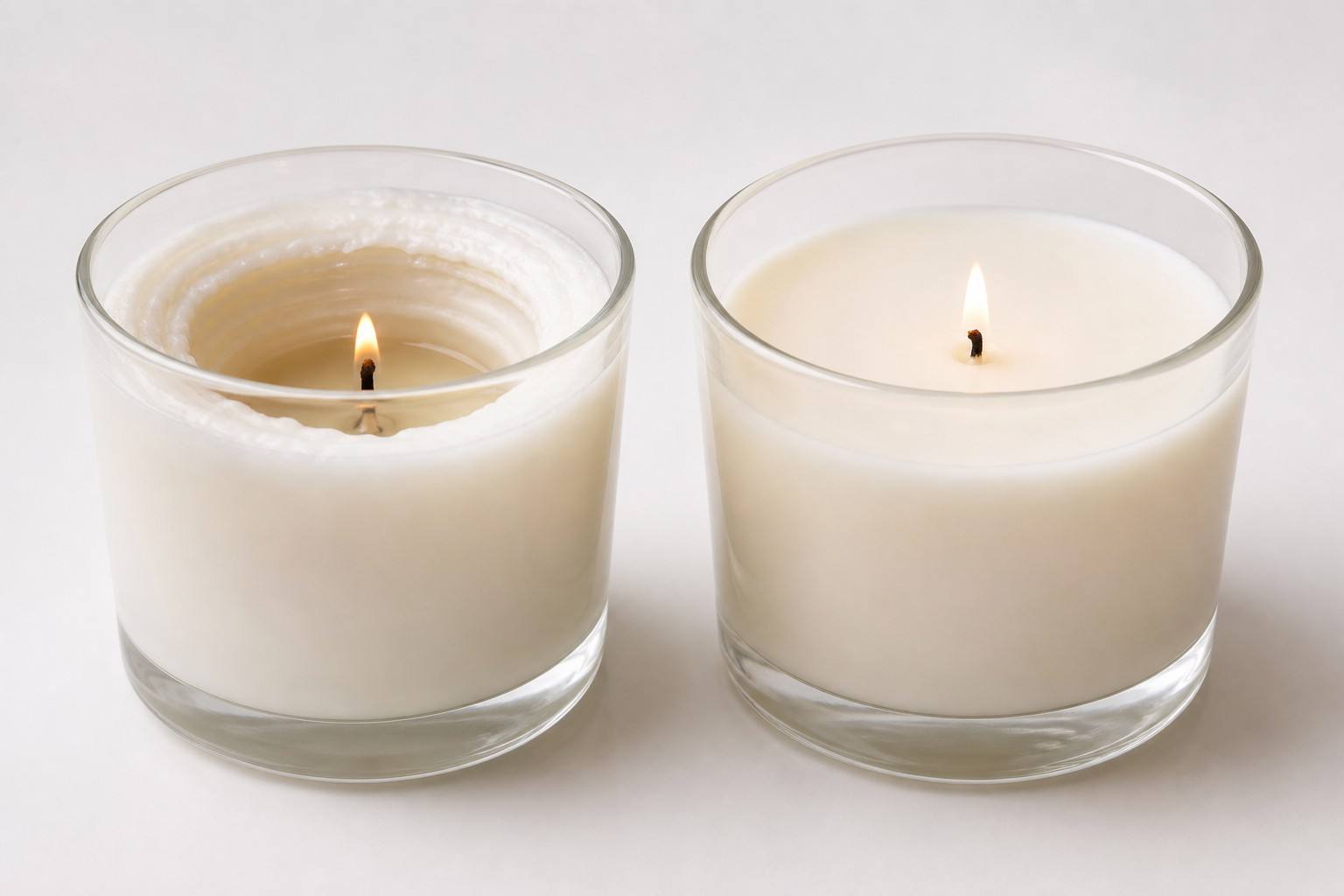
Candles possess a "physical memory." During the very first lighting, you must allow the candle to burn until the molten wax pool reaches the absolute edge of the container. For a standard jar, this usually takes 2 to 3 hours.
If you extinguish the flame before the pool reaches the edges, you create a "memory ring." In all future sessions, the wax will only melt within that center ring, leading to a phenomenon called tunneling. This leaves a thick wall of wasted wax and can reduce your candle’s effective lifespan by up to 50%.
Rule 2: The Non-Negotiable Wick Trim
Before every single light, trim the wick to 1/4 inch (6mm). This is perhaps the most overlooked step in candle care. As a wick burns, it can develop a "mushroom" shape—a buildup of carbon. If left untrimmed, this carbon buildup causes a larger, hotter, and more unstable flame. This unstable flame "gobbles" the wax, significantly shortening the life of your long burning candles and releasing unsightly black soot onto your walls and ceiling. Using dedicated diffuser accessories like a professional wick trimmer is the best way to maintain this precision.
Rule 3: The "Sweet Spot" Timing (2–4 Hour Sessions)
Timing is everything in the world of aromatherapy.
- Avoid short burns: Lighting a candle for 30 minutes prevents a full wax pool, encouraging tunneling.
- Avoid marathon burns: Burning a candle for more than 4 hours causes the vessel to overheat. When the wax becomes too liquid, the fragrance oils begin to degrade or "burn off" prematurely, and the wick may become unstable. For the best balance of fragrance release and wax longevity, aim for 3-hour sessions.
Rule 4: Strategic Placement and Airflow
Drafts are the enemy of a candle slow burn. Air currents from open windows, air conditioners, or high-traffic hallways cause the flame to dance. A flickering flame is an inefficient flame; it creates uneven heat distribution and causes one side of the wax to melt faster than the other. Always place your candles in a "still" area of the room to ensure a steady, teardrop-shaped flame.
Fragrance Lifespan vs. Physical Longevity
A common frustration among users is a candle that still has wax but no longer smells. This involves the chemistry of "Scent Throw."
- The Fragrance Pyramid: Every scent is composed of Top, Middle, and Base notes. Light top notes (like citrus or eucalyptus) evaporate the quickest. The deep base notes (like sandalwood, amber, or musk) are what you smell toward the end of the candle’s life.
- Olfactory Fatigue: Sometimes the candle isn't the problem—your nose is. If you burn the same scents candle every day, your brain eventually filters it out as "background noise." To maintain fragrance clarity, rotate your scents every few days to reset your senses.
- Storage Matters: When not in use, store your candles in a cool, dark place with their lids on. Exposure to direct sunlight or extreme temperatures can cause the fragrance oils to migrate to the surface and evaporate, leaving you with a scentless block of wax.
Knowing When to Say Goodbye: The Safety Margin
For safety and to preserve the integrity of the vessel, stop burning your candle when 1/2 inch (1.2 cm) of wax remains at the bottom. While it might be tempting to squeeze out every last minute of a long lasting candle, burning it to the very base can cause the glass to overheat and potentially crack, creating a fire hazard.
Pro Tip: Don't throw away that remaining wax! You can carefully scrape it out and use it in a wax warmer. Furthermore, premium glass vessels can be upcycled into stylish holders for makeup brushes, pens, or small succulents, extending the value of your purchase long after the flame has gone out.
Conclusion: A Partnership in Performance
So, how long does a scented candle last? Ultimately, its true lifespan is a shared responsibility between the manufacturer’s craftsmanship and the user’s ritual. A premium soy candle might provide one user with 60 hours of blissful fragrance, while another user—neglecting wicks and ignoring the first burn—might only see 30 hours of smoky frustration.
By mastering the science of the candle slow burn and respecting the "memory" of the wax, you transform from a passive consumer into an informed curator of your home ambiance. You aren't just buying a product; you are managing a sensory experience. Follow these professional guidelines to ensure that every flame is efficient, every scent is potent, and every dollar spent brings you the maximum possible value.
What is a Reed Diffuser?
How to Make Room Spray with Essential Oils? A Complete Guide to Natural, Personalized Home Fragrance
Related Article